
Background checks are now a standard part of hiring and volunteer onboarding — and for good reason. They help reduce risk, protect vulnerable populations, and ensure your organization is making informed decisions. Here's everything you need to know about what a background check includes and how the process works.
What Is a Background Check?
A background check is a screening process used to verify someone's identity and history before they are hired, contracted, or approved to volunteer. Organizations use them to confirm that information provided by an applicant is accurate and to identify potential safety risks.
A typical background check may include:
- Address history trace & identity verification
- National criminal database search
- County-level criminal record searches
- Sex offender registry checks
- Employment history verification
- Education verification
- Motor vehicle report (MVR) when relevant
- Statewide criminal searches and federal criminal searches
These screenings must comply with the Fair Credit Reporting Act (FCRA), which outlines legal requirements for employer background checks. You can see the full range of checks Bchex runs on our background checks page.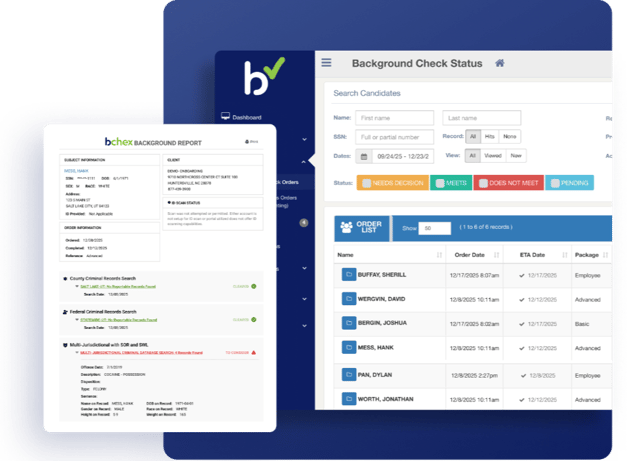
Types of Background Checks
Not every role needs the same screening. "Background check" is really a category that covers several distinct searches, and employers typically combine the ones that match the role's risk level.
Criminal background checks search county, state, federal, and national criminal databases for felony and misdemeanor records, as well as pending cases. This is the core of most screening packages.
Sex offender registry checks search all 50 state registries to flag any match — a standard requirement for roles involving contact with children, patients, or other vulnerable populations.
Employment verification confirms a candidate's prior job titles, dates of employment, and reasons for leaving directly with past employers, rather than taking a résumé at face value.
Education verification confirms degrees, certifications, and dates of attendance directly with the issuing institution.
Motor vehicle reports (MVR) pull a candidate's driving record — violations, suspensions, and DUI history — for any role that involves driving a company vehicle.
Credit checks are used selectively, mainly for roles with financial responsibility, and are subject to additional FCRA disclosure requirements.
Drug testing screens for controlled substances and is common in safety-sensitive, transportation, and healthcare roles.
Professional license verification confirms that a required license — nursing, teaching, commercial driving, and similar — is active and unencumbered.
Social media screening reviews a candidate's public social media activity for workplace risk indicators, such as threats of violence or discriminatory language.
Most employers don't run every check on every candidate. Instead, the package is scoped to the role — see the next section for how that typically breaks down.
What Jobs Require Extensive Background Checks
Some roles call for a basic criminal check. Others require a much deeper screening package because of who the employee will interact with, what they'll have access to, or what the law requires.
| Role category | What screening typically includes |
|---|---|
| Healthcare | Nurses, aides, technicians, and anyone with patient contact typically require criminal history searches, sex offender registry checks, professional license verification, and in many cases an OIG exclusion list check for facilities that bill Medicare or Medicaid. |
| Education & childcare | Teachers, school staff, coaches, and volunteers almost always require sex offender registry checks and criminal history searches, often mandated by state law rather than left to employer discretion. |
| Financial services | Banking, accounting, and any position with access to client funds commonly require credit checks in addition to criminal history, given the fiduciary responsibility involved. |
| Transportation & driving | Delivery drivers, CDL holders, and anyone operating a company vehicle require an MVR check, and DOT-regulated positions require drug testing under federal rules. |
| Government & security clearance | Government contractors and security-clearance roles require the deepest screening packages, often including federal criminal searches, extended address history, and sometimes fingerprinting. |
| Vulnerable adult services | Home health aides, senior care staff, and disability services workers typically require criminal history and sex offender registry checks similar to childcare roles. |
The pattern across all of these: the more access, trust, or vulnerability involved, the more extensive the screening should be. A one-size-fits-all package either under-screens high-risk roles or over-screens low-risk ones.
Why Background Checks Matter
Organizations across industries rely on background checks because they provide visibility into an applicant's history. Here's why they matter:
Schools, youth programs, healthcare facilities, and employers can identify criminal histories that may put people at risk. See U.S. Dept. of Justice crime statistics.
Hiring or approving someone with a violent or fraudulent background can expose an organization to significant legal damage. See EEOC guidance on negligent hiring.
Many industries — including education, childcare, transportation, and government — require screening by law. State-by-state screening mandates vary considerably.
SHRM reports that 53% of resumes contain inaccuracies or omissions.
A structured, consistent screening process ensures fairness and accuracy, reducing turnover and improving workforce quality.
How Background Checks Work
Although results appear simple on the surface, the background check process is detailed and multilayered. Here's how it works:
Applicant consent
Before screening begins, an applicant must sign an electronic disclosure and authorization, as required by the FCRA.
Address history trace & identity verification
This foundational step uncovers address history and known aliases, ensuring the search covers all relevant jurisdictions.
National criminal database search
This broad scan identifies potential criminal records and flags counties needing deeper research. See the National Center for State Courts for background on how criminal record systems are organized nationally.
County-level criminal searches
County courts often hold the most accurate and up-to-date criminal information. Researchers check felony records, misdemeanor records, and pending cases.
Sex offender registry check
All 50 states are searched for registered sex offenders. See the National Sex Offender Public Website (NSOPW) for the national registry.
Verification checks (optional)
Employers may add employment verification, education verification, and professional license verification.
Result compilation & compliance review
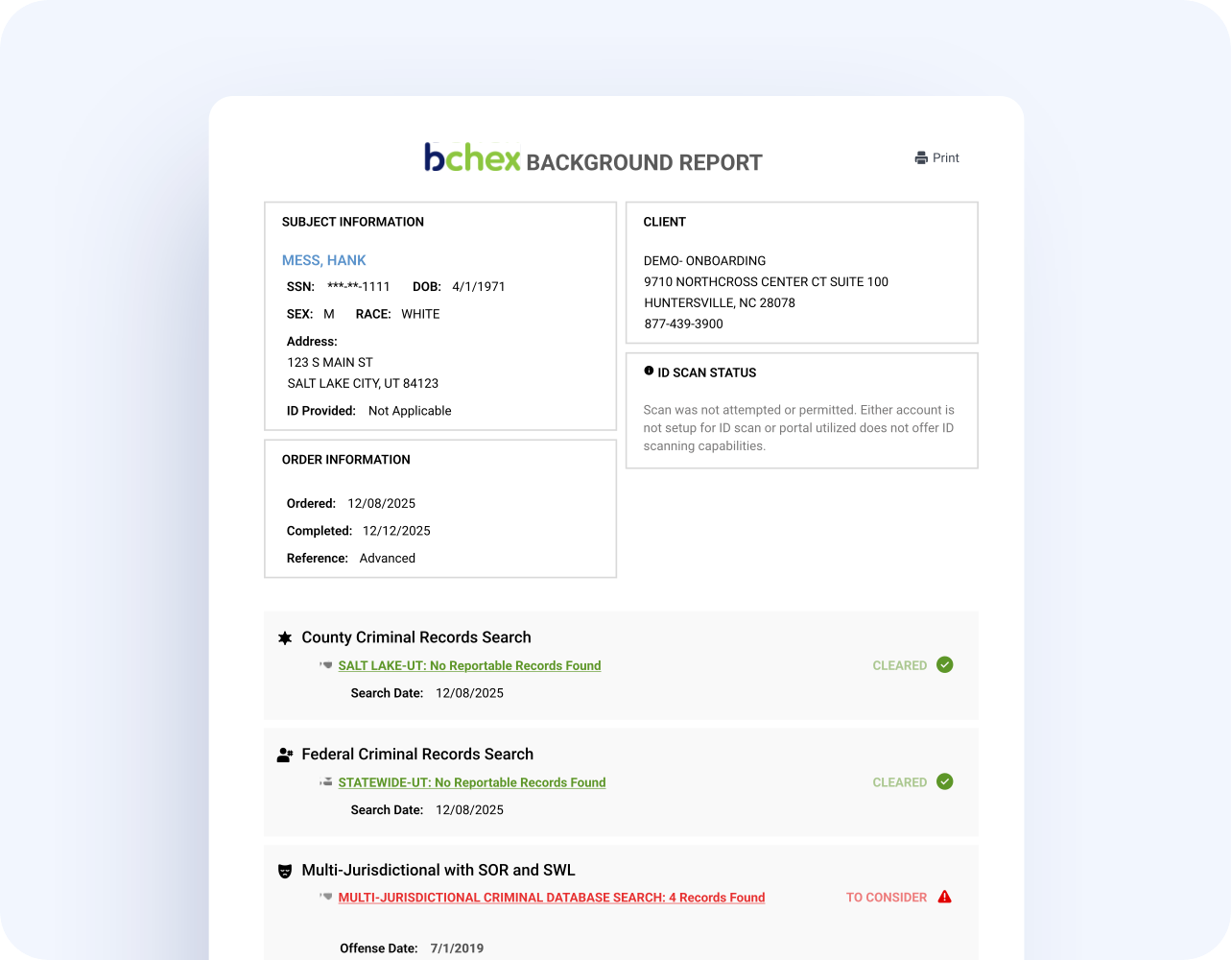
Once complete, results are compiled into a report and returned through the screening dashboard. Bchex ensures everything meets FCRA and state compliance standards.
How to Conduct a Background Check With Bchex
Here's what running a background check actually looks like inside the Bchex platform, from order to result.
Start the order
From your Bchex dashboard, select the candidate or role type and choose the check package that fits — or build a custom package from individual searches.
Send the disclosure and consent request
Bchex sends the candidate a secure link to complete the FCRA-required disclosure and authorization electronically — no paper, no manual chasing.
Candidate completes their information
The candidate enters their identifying information directly into the secure applicant portal, which Bchex uses to run the address history trace and route the criminal search to the correct jurisdictions.
Bchex runs the verifications
Behind the scenes, Bchex processes the address history trace, criminal searches, sex offender registry check, and any additional verifications included in the package.
Review results on your dashboard
Results populate directly in your Bchex dashboard as they clear, with clear status indicators so you always know what's still pending versus complete.
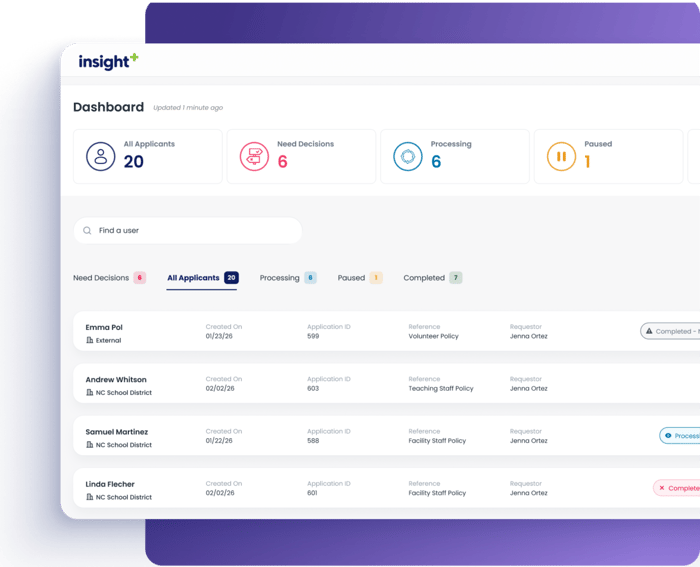
Use Insight+ for adjudication support
For organizations using Insight+, flagged results are automatically reviewed against your adjudication criteria to help you move faster on records that need a closer look — while keeping a human in the loop on the final call.
Follow the adverse action process if needed
If a result factors into a decision not to hire, Bchex's workflow supports the FCRA's pre-adverse and final adverse action steps directly from the dashboard.
The entire flow — from sending the disclosure to reviewing a completed result — happens in one platform, without switching between separate consent forms, court-record lookups, and spreadsheets.
How Long Does a Background Check Take?
Turnaround depends on which checks are included and how quickly the underlying records are available — but with Bchex, most candidates aren't waiting long. 86% of qualifying searches return in under 5 business hours, and eligible searches are backed by a 1-Business-Day Delivery Guarantee.
A few factors affect timing regardless of provider:
- County court digitization. Some counties post records instantly online; others require a records request that takes longer to process.
- Verification response times. Employment and education verifications depend on how quickly a past employer or school responds.
- Number of jurisdictions searched. A candidate with a long address history across several states will take longer than one with a single-county search.
- Additional checks. Drug testing, MVR, and professional license verification each add their own turnaround on top of the criminal search.
Most standard checks through Bchex complete well within 1–3 business days, and the dashboard shows real-time status so you're never left guessing whether a result is still pending or simply hasn't been ordered yet.
Benefits of Background Checks
Background checks directly support safer, smarter hiring processes:
- Lower risk of workplace violence
- Safer environments for students, families, and vulnerable groups
- Better-informed hiring decisions
- Reduced fraud and misrepresentation
- Compliance with state and federal screening laws
- Faster onboarding with modern digital workflows
- Stronger reputation and community trust
FAQs About Background Checks
What information shows up on a background check?+
How far back does a background check go?+
How long does a background check take?+
Are background checks required for volunteers?+
What makes a background check accurate?+
What is a red flag in a background check?+
What will make you fail a background check?+
Conclusion
A background check is one of the most important tools for creating a safe, trustworthy workforce. With the right screening partner, organizations benefit from accuracy, compliance, and faster hiring decisions.
Want to streamline your screening process? Bchex delivers fast, accurate, FCRA-compliant background checks designed for schools, employers, and volunteer programs.
Related reading: Arrests vs. Convictions: Understanding What Shows Up on a Background Check · How Long Does a Volunteer Background Check Take? · Background Check Red Flags: What Employers Look For · How to Choose the Right Type of Background Check for Your Organization · Unlocking Accuracy in Background Checks: The Power of Bchex's ID Scan Technology
See our background check services
Fast, accurate, FCRA-compliant background checks designed for schools, employers, and volunteer programs.